Typecasting
Typecasting is an operation that converts a value in one particular data type to the closest corresponding value in another data type. Like other SQL engines, SereneDB supports both implicit and explicit typecasting.
Explicit Casting
Explicit typecasting is performed by using a CAST expression. For example, CAST(col AS VARCHAR) or col::VARCHAR explicitly cast the column col to VARCHAR. See the cast page for more information.
Implicit Casting
In many situations, the system will add casts by itself. This is called implicit casting and happens, for example, when a function is called with an argument that does not match the type of the function but can be cast to the required type.
Implicit casts can only be added for a number of type combinations, and is generally only possible when the cast cannot fail. For example, an implicit cast can be added from INTEGER to DOUBLE – but not from DOUBLE to INTEGER.
Consider the function sin(DOUBLE). This function takes as input argument a column of type DOUBLE, however, it can be called with an integer as well: sin(1). The integer is converted into a double before being passed to the sin function.
Combination Casting
When values of different types need to be combined to an unspecified joint parent type, the system will perform implicit casts to an automatically selected parent type. For example, list_value(1::INT64, 1::UINT64) creates a list of type INT128[]. The implicit casts performed in this situation are sometimes more lenient than regular implicit casts. For example, a BOOL value may be cast to INT (with true mapping to 1 and false to 0) even though this is not possible for regular implicit casts.
This combination casting occurs for comparisons (= / < / >), set operations (UNION / EXCEPT / INTERSECT), and nested type constructors (list_value / [...] / MAP).
Casting Operations Matrix
Values of a particular data type cannot always be cast to any arbitrary target data type. The only exception is the NULL value – which can always be converted between types.
The following matrix describes which conversions are supported.
When implicit casting is allowed, it implies that explicit casting is also possible.
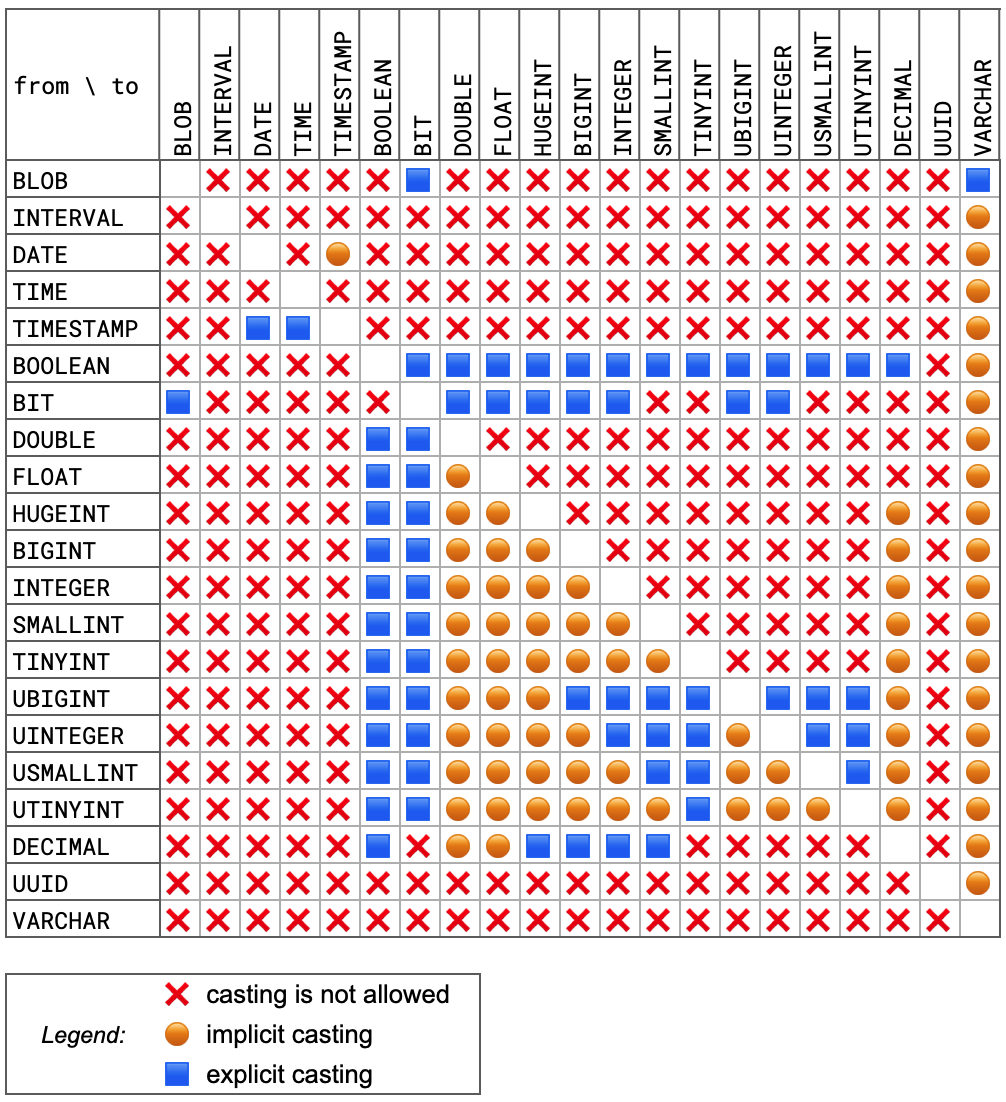
Even though a casting operation is supported based on the source and target data type, it does not necessarily mean the cast operation will succeed at runtime.
Lossy Casts
Casting operations that result in loss of precision are allowed. For example, it is possible to explicitly cast a numeric type with fractional digits – such as DECIMAL, FLOAT or DOUBLE – to an integral type like INTEGER or BIGINT. The number will be rounded.
SELECT CAST(3.1 AS INTEGER);
SELECT CAST(3.5 AS INTEGER);
SELECT CAST(-1.7 AS INTEGER); int4------ 3
int4------ 4
int4------ -2Overflows
Casting operations that would result in a value overflow throw an error. For example, the value 999 is too large to be represented by the TINYINT data type. Therefore, an attempt to cast that value to that type results in a runtime error:
SELECT CAST(999 AS TINYINT);db error: ERROR: Type INT32 with value 999 can't be cast because the value is out of range for the destination type INT8So even though the cast operation from INTEGER to TINYINT is supported, it is not possible for this particular value. TRY_CAST can be used to convert the value into NULL instead of throwing an error.
Varchar
The VARCHAR type acts as a universal target: any arbitrary value of any arbitrary type can always be cast to the VARCHAR type. This type is also used for displaying values in the shell.
SELECT CAST(42.5 AS VARCHAR); text------ 42.5Casting from VARCHAR to another data type is supported, but can raise an error at runtime if SereneDB cannot parse and convert the provided text to the target data type.
SELECT CAST('NotANumber' AS INTEGER);db error: ERROR: Could not convert string 'NotANumber' to INT32In general, casting to VARCHAR is a lossless operation and most scalar types can be cast back to the original type after being converted into text. Nested types are an exception: a list is rendered in text as [1, 2, 3], but casting text back to a list requires the PostgreSQL array form {1, 2, 3}. As a result, the textual representation of a list cannot be cast directly back to a list.
SELECT CAST(CAST([1, 2, 3] AS VARCHAR) AS INTEGER[]); list_value------------ {1,2,3}Literal Types
Integer literals (such as 42) and string literals (such as 'string') have special implicit casting rules. See the literal types page for more information.
Lists / Arrays
Lists can be explicitly cast to other lists using the same casting rules. The cast is applied to the children of the list. For example, if we convert an INTEGER[] list to a VARCHAR[] list, the child INTEGER elements are individually cast to VARCHAR and a new list is constructed.
SELECT CAST([1, 2, 3] AS VARCHAR[]); list_value------------ {1,2,3}Arrays
Arrays follow the same casting rules as lists. In addition, arrays can be implicitly cast to lists of the same type. For example, an INTEGER[3] array can be implicitly cast to an INTEGER[] list.
Structs
Structs can be cast to other structs as long as they share at least one field.
SELECT CAST({'a': 42} AS STRUCT(a VARCHAR)); struct_pack------------- (42)Fields that exist in the target struct, but that do not exist in the source struct, default to NULL.
SELECT CAST({'a': 42} AS STRUCT(a VARCHAR, b VARCHAR)); struct_pack------------- (42,)Fields that only exist in the source struct are ignored.
SELECT CAST({'a': 42, 'b': 43} AS STRUCT(a VARCHAR)); struct_pack------------- (42)The names of the struct can also be in a different order. The fields of the struct will be reshuffled based on the names of the structs.
SELECT CAST({'a': 42, 'b': 84} AS STRUCT(b VARCHAR, a VARCHAR)); struct_pack------------- (84,42)For combination casting, the fields of the resulting struct are the superset of all fields of the input structs. This logic also applies recursively to potentially nested structs.
SELECT {'outer1': {'inner1': 42, 'inner2': 42}} AS cUNIONSELECT {'outer1': {'inner2': 'hello', 'inner3': 'world'}, 'outer2': '100'} AS c; c------------------------ ("(,hello,world)",100) ("(42,42,)",)SELECT [{'a': 42}, {'b': 84}]; list_value------------------- {"(42,)","(,84)"}Unions
Union casting rules can be found on the UNION type page.